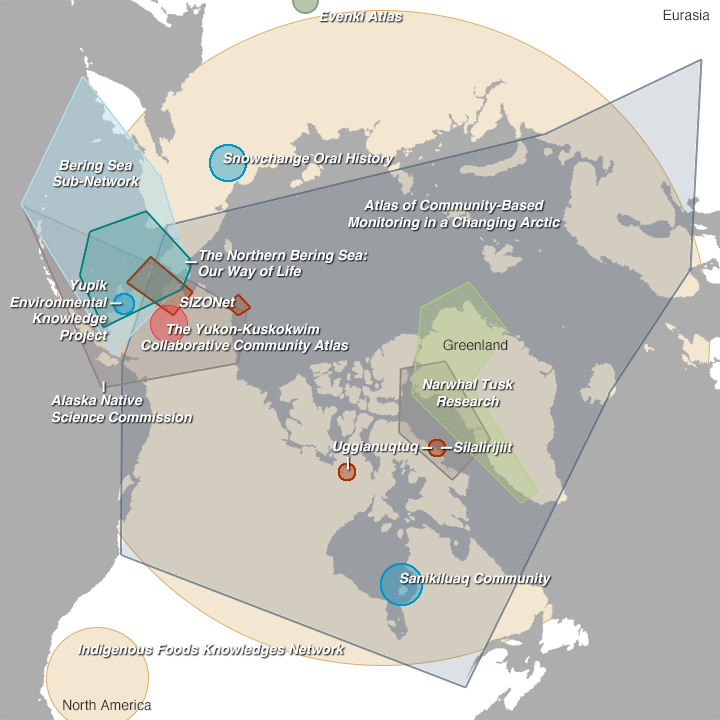
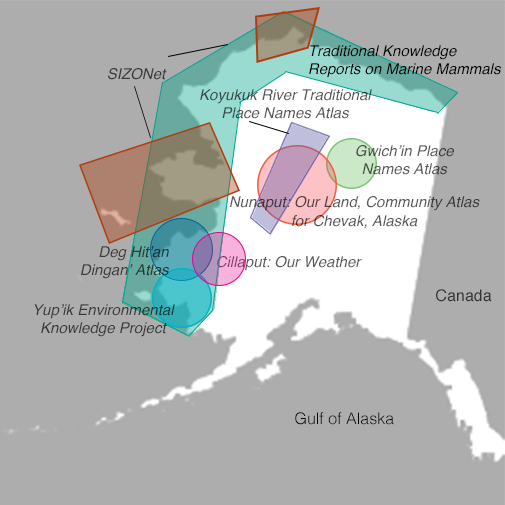
ELOKA partners with Indigenous communities in the Arctic to create online products that facilitate the collection, preservation, exchange, and use of local observations and Indigenous Knowledge of the Arctic. ELOKA fosters collaboration between resident Arctic experts and visiting researchers, provides data management and user support, and develops digital tools for Indigenous Knowledge in collaboration with our partners. By working together, Arctic residents and researchers can make significant contributions to a deeper understanding of the Arctic and the social and environmental changes ongoing in the region.
Arctic residents and Indigenous peoples have been increasingly involved in, and taking control of, research. Through Local and Indigenous Knowledge and community-based monitoring, Arctic communities have made, and continue to make, significant contributions to understanding recent Arctic change. In ELOKA’s work, we subscribe to ideas of information and data sovereignty, in that we want our projects to be community-driven with communities having control over how their data, information, and knowledge are shared in an ethical manner.
A key challenge of Local and Indigenous Knowledge research and community-based monitoring to date is having an effective and appropriate means of recording, storing, representing, and managing data and information in an ethical manner. Another challenge is to find an effective means of making such data and information available to Arctic residents and researchers, as well as other interested groups such as teachers, students, and decision-makers. Without a network and data management system to support Indigenous Knowledge and community-based research, a number of problems have arisen, such as misplacement or loss of extremely precious data, information, and stories from Elders who have passed away, a lack of awareness of previous studies causing repetition of research and wasted resources occurring in the same communities, and a reluctance or inability to initiate or maintain community-based research without an available data management system. Thus, there is an urgent need for effective and appropriate means of recording, preserving, and sharing the information collected in Arctic communities. ELOKA aims to fill this gap by partnering with Indigenous communities to ensure their knowledge and data are stored in an ethical way, thus ensuring sovereignty over these valuable sources of information.
ELOKA's overarching philosophy is that Local and Indigenous Knowledge and scientific expertise are complementary and reinforcing ways of understanding the Arctic system. Collecting, documenting, preserving, and sharing knowledge is a cooperative endeavor, and ELOKA is dedicated to fostering that shared knowledge between Arctic residents, scientists, educators, policy makers, and the general public. ELOKA operates on the principle that all knowledge should be treated ethically, and intellectual property rights should be respected.
ELOKA is a service available for research projects, communities, organizations, schools, and individuals who need help storing, protecting, and sharing Local and Indigenous Knowledge. ELOKA works with many different types of data and information, including:
- Written interview transcripts
- Audio or video tapes and files
- Photographs, artwork, illustrations, and maps
- Digital geographic information such as GPS tracks, and data created using Geographic Information Systems
- Quantitative data such as temperature, snow thickness, wind data, etc.
- Many other types of Indigenous Knowledge and local observations, including place names
ELOKA collaborates with other organizations engaged in addressing data management issues for community-based research. Together, we are working to build a community that facilitates international knowledge exchange, development of resources, and collaboration focused on local communities and stewardship of their data, information, and knowledge.